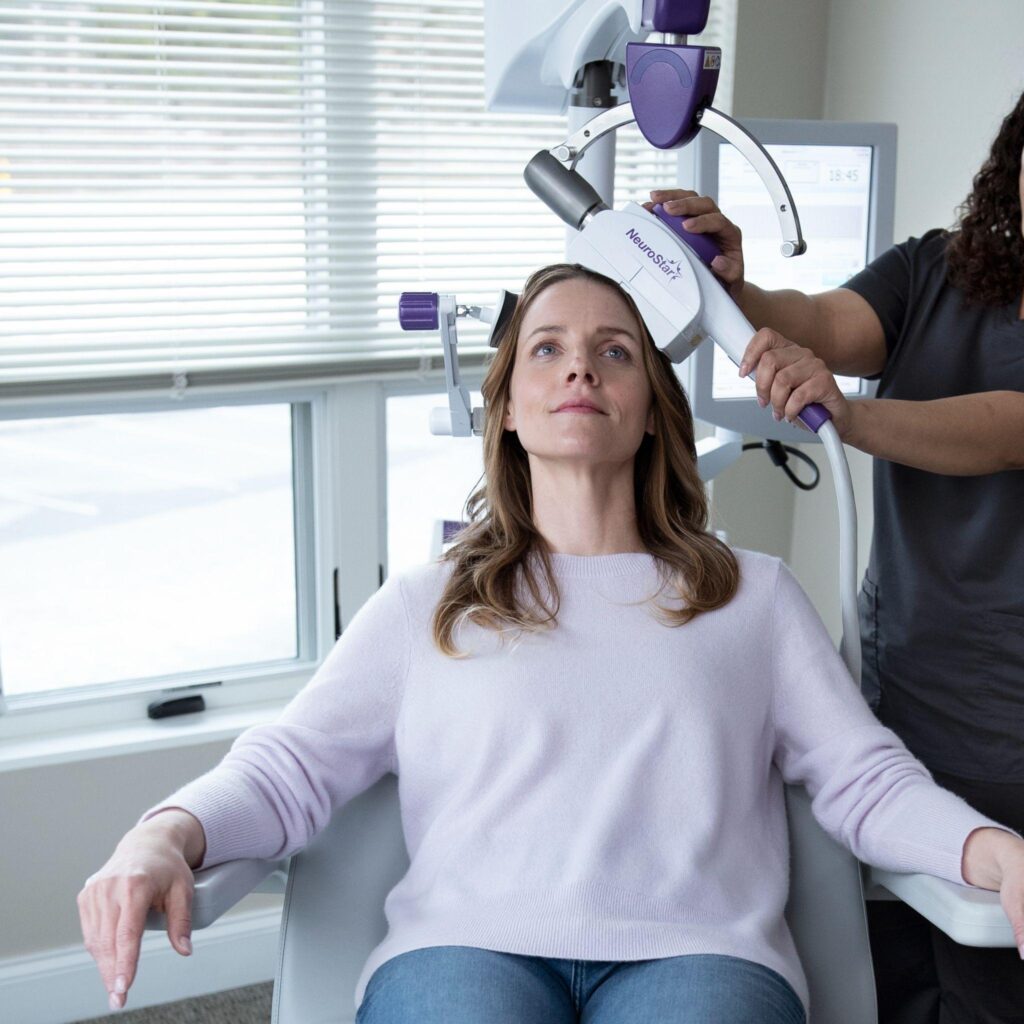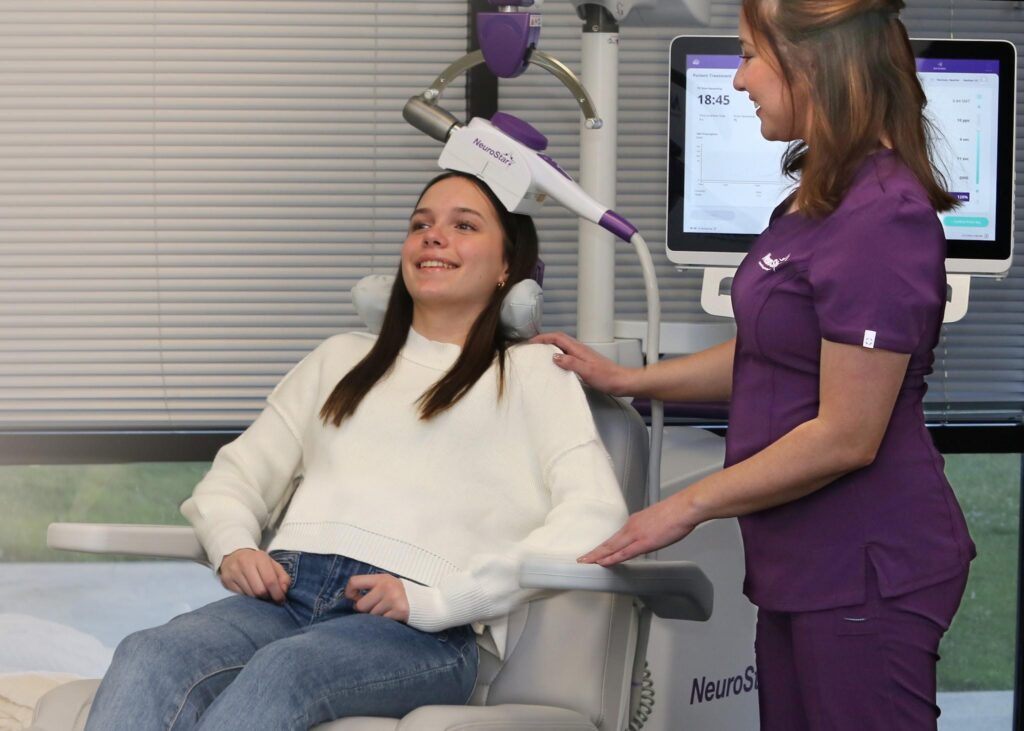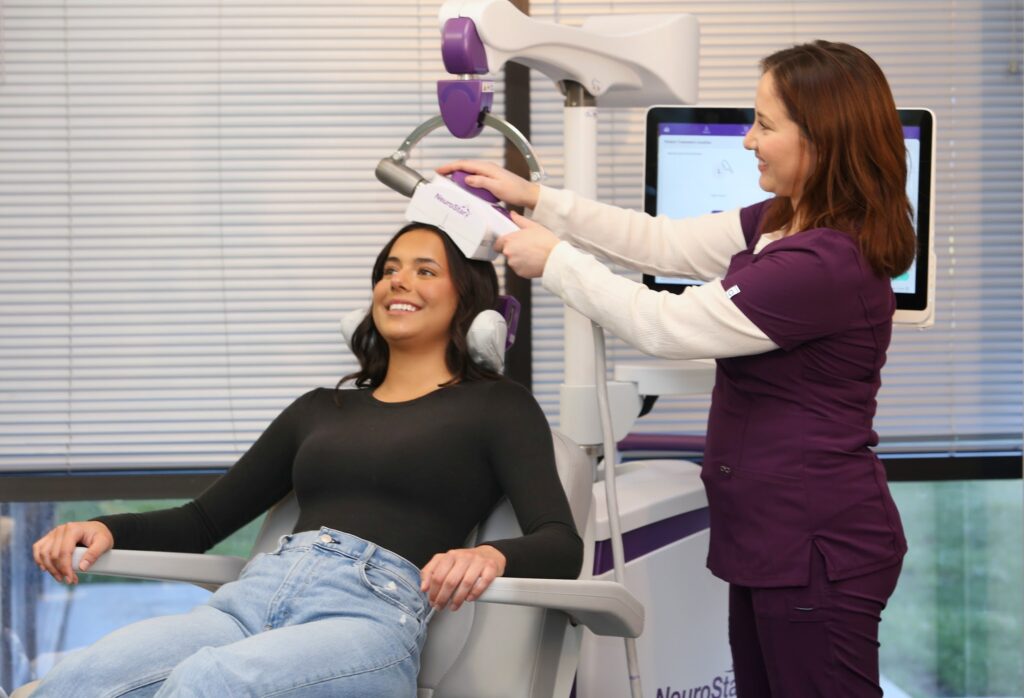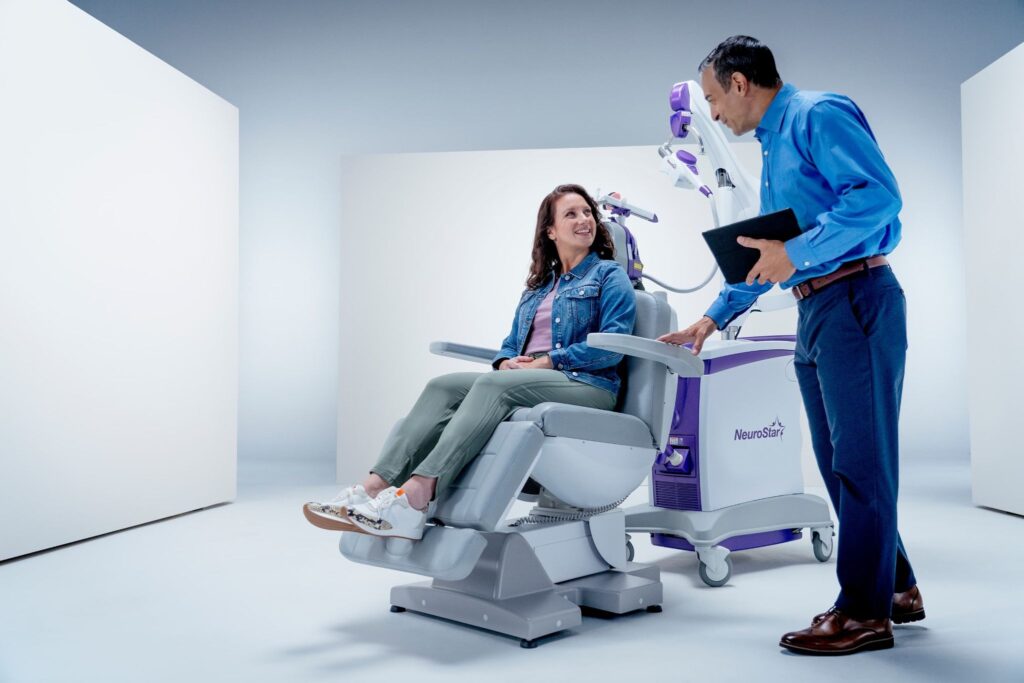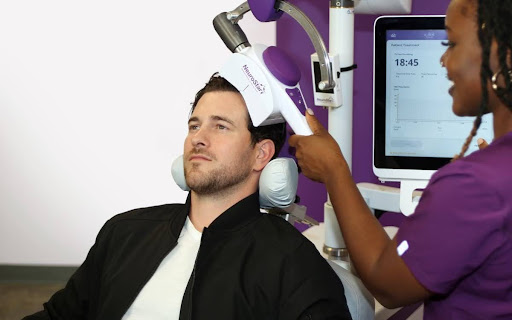


Transcranial magnetic stimulation (TMS) gradually reduces depression symptoms by using targeted magnetic pulses to stimulate underactive brain regions. Clinical research demonstrates its effectiveness, with real-world analyses showing an average 39% reduction in PHQ-9 scores among patients with severe depression.
Understanding what to expect before and after TMS therapy helps you set realistic expectations and monitor your daily recovery milestones. Continue reading for a clear breakdown of clinical preparation, session experiences, and post-treatment progress.
Key Takeaways
- TMS begins with psychiatric evaluation, safety screening, baseline symptom measurements, and personalized motor threshold mapping.
- Meaningful changes can develop gradually, with sleep, energy, mood, motivation, and concentration improving at different times.
- Before-and-after results should combine standardized scores such as PHQ-9 with changes in daily functioning and clinical remission.
What Should You Expect Before TMS Therapy?
Before TMS begins, the clinical team confirms the diagnosis, reviews previous treatments, checks safety factors, and establishes measurable baseline symptoms.
A comprehensive psychiatric evaluation usually reviews depression severity, previous antidepressant trials, psychotherapy, current medications, psychiatric history, and treatment goals.
As highlighted in clinical research from the Cleveland Clinic:
“TMS serves as a proven noninvasive treatment option when depression has not responded adequately to conventional approaches.”
Safety screening also matters. Certain implanted medical devices, non-removable metal near the treatment area, and some neurological conditions can affect eligibility. The clinician may also review seizure history and medications that could influence seizure risk.
Baseline measurements create the reference point for evaluating progress throughout an individualized TMS therapy for depression. Common tools include:
- PHQ-9 for depression severity
- HAM-D for depressive symptoms
- GAD-7 when anxiety symptoms are clinically relevant
A standard depression course commonly involves treatment 5 days per week for approximately 4 to 6 weeks, although protocols vary by diagnosis and device.
The goal is not simply to begin stimulation. The goal is to establish whether TMS is clinically indicated and create a measurable before-and-after comparison.
How Does Motor Threshold Mapping Affect Your TMS Treatment?
Motor threshold mapping determines the minimum stimulation intensity needed to produce a measurable motor response, allowing clinicians to personalize the treatment dose.
During mapping, the clinician identifies the stimulation intensity that produces a small movement, commonly involving the thumb or hand. Standard systems use motor-threshold assessment as part of their treatment approach to help establish individualized stimulation parameters.
The measured threshold can change as treatment progresses. Clinicians may therefore reassess stimulation intensity when clinically appropriate rather than assuming that the initial setting remains optimal throughout the entire course.
This process also demonstrates why TMS is not simply a fixed electrical dose delivered identically to every patient. Coil positioning, treatment target, stimulation intensity, and protocol all influence the treatment plan.
For depression, many patients receive approximately 30 to 36 sessions, although the exact number depends on the clinical protocol and patient response.
That personalization becomes especially relevant when evaluating TMS treatment results, as two patients can receive the same protocol while requiring different stimulation settings and clinical timelines.
When Do People Typically Notice Changes During TMS?

TMS improvement often develops gradually, with early changes sometimes appearing in sleep or energy before broader improvements in mood, motivation, and concentration.
Treatment Timeline Phases
- Weeks 1 and 2 (Early treatment): Some patients report changes in sleep, alertness, energy, or mental fog. These changes do not necessarily mean that depression has entered remission.
- Weeks 3 and 4 (Middle treatment): Improvements may become more noticeable in mood, motivation, concentration, and emotional engagement. However, some patients respond earlier, while others require most of the treatment course.
- Weeks 5 and 6 (Later treatment): Clinicians may focus on consolidating improvement and determining whether symptoms have reached response or remission levels.
- Follow-up: Clinicians assess whether improvement continues after treatment ends.
That said, a slow response does not automatically mean treatment failure. Some patients are later responders, making the complete treatment course and follow-up assessment clinically relevant.
What Is the TMS “Dip,” and When Should You Discuss It?

A TMS “dip” describes a temporary period when depressive or anxiety symptoms appear worse during treatment, although this experience is not universal and is not a formal prediction for every patient.
Patients may describe increased anxiety, lower mood, emotional discomfort, or concern that treatment is failing. Scalp discomfort can also make an early treatment period feel more difficult.
The reported timing varies. Some patient communities describe a dip around days 15 to 20, but that timing should not be treated as a universal clinical rule.
When to contact the treating team:
- Symptoms worsen meaningfully
- Suicidal thinking develops
- Anxiety becomes difficult to manage
- Patient experiences a substantial change from baseline
Clinicians can then determine whether the change represents a temporary treatment effect, progression of the underlying disorder, medication-related change, or another clinical issue. The most useful approach is to compare symptoms against baseline rather than assuming every difficult day represents a treatment dip.
How Can You Tell Whether TMS Is Working?

TMS appears to be working when standardized symptom scores and real-world functioning show sustained improvement rather than relying on a single good or bad day.
Clinicians use tools like the PHQ-9, HAM-D, and GAD-7 alongside objective benchmarks in advanced psychiatric care to measure progress in sleep quality, concentration, and emotional stability.
For example, a patient whose PHQ-9 score falls from 23 to 1 has demonstrated a substantial measurable change. Another patient moving from 25 to 14 has improved but may still have clinically relevant symptoms.
A 2026 real-world analysis of 355 patients found clinically meaningful improvement in 61% of patients receiving at least 30 TMS sessions. Among patients with severe depression, the average PHQ-9 score decreased from 19.67 to 11.90, approximately a 39% reduction.
These figures describe groups, not individual guarantees.
What Does Meaningful Improvement Look Like After TMS?
Meaningful improvement after TMS usually involves both lower symptom severity and better daily functioning, while remission represents a more complete reduction of clinically significant symptoms.
| Measure | Before TMS | After Meaningful Improvement |
| Depression score | Elevated | Substantially lower |
| Sleep | Disrupted | More consistent |
| Energy | Reduced | Improved |
| Concentration | Impaired | More reliable |
| Motivation | Limited | Greater engagement |
| Daily function | Difficult | More manageable |
A patient who previously struggled to get out of bed but later returns to work, reconnects socially, sleeps more consistently, and experiences greater motivation may have clinically meaningful functional improvement.
Response and remission should still be distinguished. A response generally refers to a substantial reduction in symptoms, while remission indicates that symptoms have fallen to a minimal level according to accepted clinical criteria.
The most reliable clinical assessment combines numerical symptom changes with observable, everyday functional improvements.
Why Might TMS Not Work for Everyone?

TMS does not produce the same response in every patient, and limited improvement can reflect differences in diagnosis, treatment history, protocol, targeting, or individual biology.
If a patient completes a full course and still experiences substantial depressive symptoms, the treating psychiatrist may reconsider:
- The original diagnosis and comorbid conditions
- Stimulation target and coil positioning
- Treatment protocol and adherence
- Medication history and degree of symptom change
Could Protocol Adjustments Improve TMS Therapy Results?
Protocol or targeting may warrant review when symptoms show little improvement despite adequate treatment exposure. Motor threshold, coil positioning, stimulation intensity, and treatment target can all matter. A second opinion may also help when the expected response does not occur.
When Might a Second Course Support TMS Recovery?
A second TMS course may be discussed when a patient previously responded, experienced partial benefit, or later develops recurrent symptoms after an initial successful course. Additional treatment depends on clinical response and the treating clinician’s assessment.
What Side Effects Can Happen Before and After Each TMS Session?
TMS side effects are usually mild and temporary, with headache and scalp discomfort among the most common reactions during treatment.
TMS does not require general anesthesia, so patients remain awake during treatment. Magnetic pulses may create a tapping sensation around the treatment area, while nearby scalp muscles can produce brief involuntary movements. Standard clinical literature identifies mild headaches and localized scalp sensitivity as the most common temporary effects.
Common effects include:
- Headache or scalp discomfort
- Temporary fatigue
- Tapping or clicking sensations
- Temporary muscle movement around the treatment area
More serious complications, such as seizures, are extremely rare. Because of this, a comprehensive pre-treatment psychiatric evaluation is conducted to review each patient’s medical history and individual risk factors before stimulation ever begins.
Can You Return to Normal Activities After TMS?
Most patients can return to normal activities immediately after TMS because the treatment does not require sedation or a recovery period.
A typical session lasts approximately 20 to 40 minutes, depending on the protocol. Patients may drive, work, attend school, exercise, and continue ordinary responsibilities when they feel physically well enough.
This convenience allows TMS to fit into a regular weekday schedule. Standard depression treatment often involves approximately 30 to 36 sessions, commonly delivered five days per week.
What Happens After You Complete the Full TMS Course?
After completing TMS, the clinician reassesses symptom severity, daily functioning, medications, psychotherapy, and whether treatment gains are stable.
A follow-up assessment approximately 2 to 4 weeks after treatment can provide a clearer picture than measuring symptoms immediately after the final session. The post-treatment review evaluates clinical stability and determines whether ongoing care or specialized TMS treatment should remain part of the patient’s long-term mental health management.
The post-treatment review may examine:
- PHQ-9, HAM-D, or GAD-7 scores
- Sleep, energy, concentration, and motivation
- Work and social functioning
- Current medications and psychotherapy support
- Whether additional TMS is clinically appropriate
How Long Can TMS Benefits Last After Treatment?
TMS benefits can persist for months, although duration varies according to the patient’s diagnosis, response, treatment history, and ongoing mental health care. Clinical evidence suggests sustained outcomes through 12 months for many patients.
| Period | Clinical Focus |
| End of treatment | Measure response and functional improvement |
| 2–4 weeks | Confirm early stability |
| Following months | Monitor symptom recurrence |
| Recurrence | Reassess treatment options |
| Long-term | Individualize maintenance and follow-up |
How Should You Compare TMS Results Before and After Treatment?
The clearest TMS results come from comparing standardized symptom measurements and daily functioning at several points rather than relying on memory alone.
| Assessment Point | What Clinicians May Evaluate |
| Baseline | PHQ-9, HAM-D, GAD-7, functioning |
| Mid-treatment | Symptom trajectory and tolerability |
| End of treatment | Response, remission, and functioning |
| 2–4 week follow-up | Stability after treatment |
| Long-term follow-up | Durability and recurrence |
What Should You Ask a TMS Clinic Before Starting?
A prospective patient should understand why TMS is being recommended and how the treatment fits into the broader psychiatric treatment plan.
NeuroStar Advanced Therapy is FDA-cleared to treat major depressive disorder in adults who have not seen satisfactory improvement from antidepressant medication, and as an add-on treatment for adults with obsessive-compulsive disorder (OCD).
Useful questions include:
- What diagnosis makes TMS clinically appropriate?
- Which TMS protocol and treatment target will be used?
- How will motor threshold be measured and symptoms tracked?
- What happens if symptoms temporarily worsen?
- How many sessions are expected and what follow-up occurs?
- What costs and insurance considerations apply?
What Should You Remember About Before and After TMS Therapy?
Evaluating treatment progress is an ongoing clinical process that pairs objective symptom scores with meaningful everyday recovery, like restored sleep patterns, clearer concentration, and improved emotional energy.
At TMS Center of NJ, personalized protocols support long-term relief for individuals navigating depression and OCD. Contact TMS Center of NJ today to schedule an evaluation and discuss whether TMS fits your care plan.
FAQ
How soon can TMS results appear?
Some patients notice initial improvements during the first two to three weeks of treatment, whereas others may require four to six weeks (or 30 to 36 complete sessions) before demonstrating measurable clinical progress.
What changes can patients expect before and after TMS therapy?
Before beginning treatment, patients often struggle with persistent low mood, disrupted sleep, chronic fatigue, and cognitive fog. After completing a recommended course, patients typically show marked drops in clinical scores (like the PHQ-9) alongside tangible daily gains, such as stabilized sleep, restored concentration, and improved emotional resilience.
What is the TMS success rate?
Response and remission rates vary depending on individual medical history and depression severity. Clinical analyses indicate that approximately 61% of patients receiving at least 30 TMS sessions achieve clinically meaningful symptom reduction, with severe depression scores decreasing by an average of 39%.
Is TMS painful?
TMS is noninvasive and generally well tolerated. During or immediately following a session, patients may experience a mild tapping sensation on the head, minor scalp discomfort at the stimulation site, or temporary mild headaches.
Can patients work or drive after TMS?
Yes, patients can drive, return to work, and resume all normal daily activities immediately after a session because TMS is noninvasive and requires no anesthesia or sedation.
References